
Looted in Hungary: Hatvany Deutsch Library
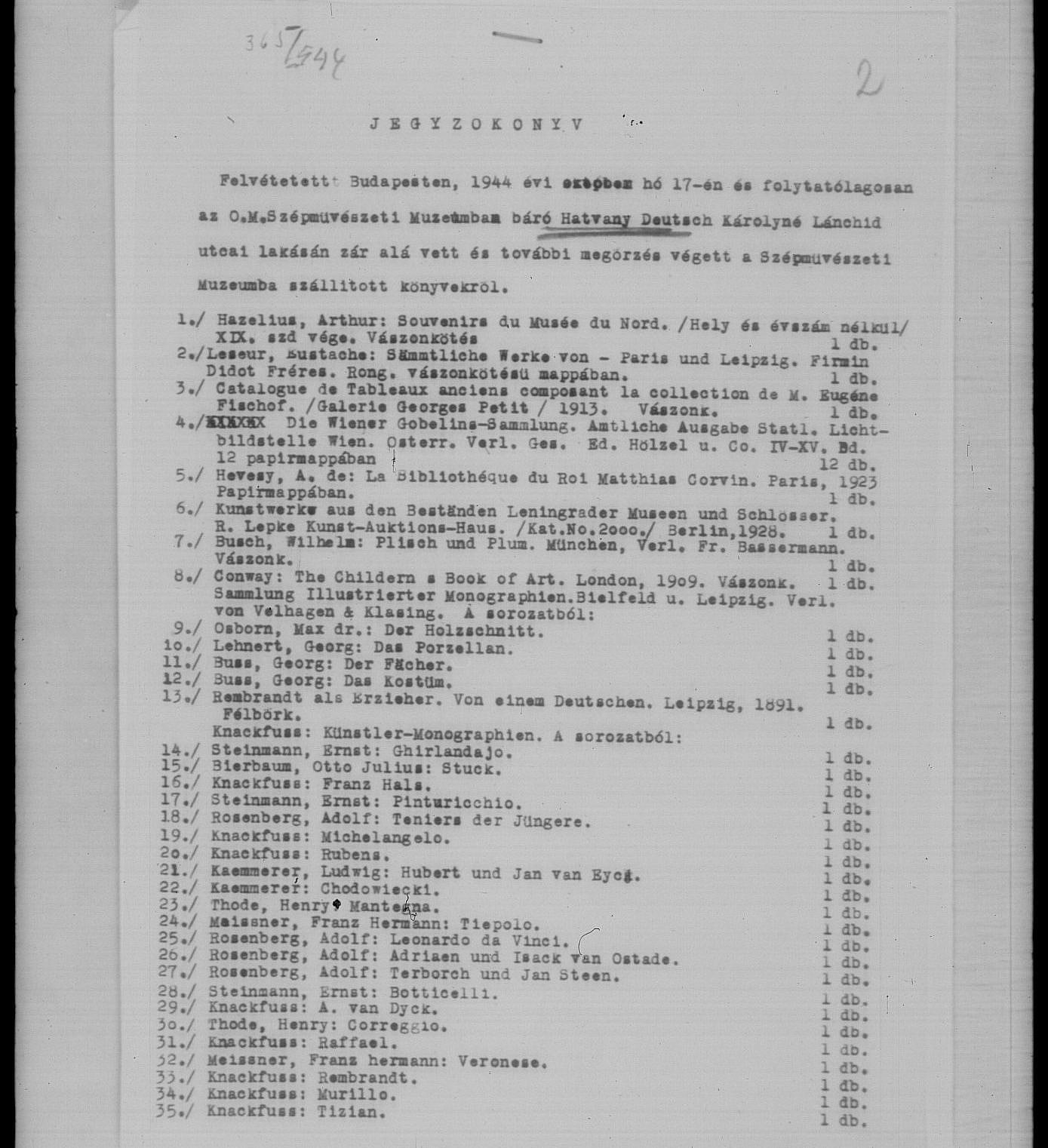
In the autumn of 1944, as deportations of Hungary’s Jews entered their final months, the country’s cultural institutions were not bystanders. They were active participants in a program of state-directed cultural plunder. One case—preserved across three consecutive archival slides—illustrates the machinery of theft in granular detail: the forced transfer of Baroness Hatvany Deutsch Károlyné’s private library from her Budapest home into the custody of the Museum of Fine Arts.
The evidence is not anecdotal. It is a bureaucratic artifact, typed and signed on official forms, dated October 17, 1944, and recorded under the authority of the Government Commissioner for the Inventory and Safekeeping of Property Seized from Jews.
A Victim Known by Name
Unlike many wartime seizure records that anonymize victims, this protocol preserves the Baroness’s name and address—Lánchíd Street, a prestigious address in Budapest’s center. The Hatvany family were well-known Jewish art patrons and collectors, targeted precisely because of the cultural value of their holdings.
What these three pages show is not the seizure of random furniture or household goods. They describe, item by item, an art-historical reference library—a curated collection assembled over decades, and one that reflected both personal taste and scholarly discernment.
The Museum’s Role
The receiving institution was not a warehouse or police station. It was one of Hungary’s leading national museums, the Museum of Fine Arts. The protocol and its continuations list the items as if for a new accession:
-
Sequential numbering from item 1 to item 83.
-
Detailed bibliographic descriptions: author, title, publisher, date.
-
Notation of binding types (paper, half-leather, full leather, parchment).
-
Final handling instruction: “Placed into box and into a cupboard.”
This is museum intake language, not emergency safekeeping. It demonstrates how cultural institutions integrated looted property into their custody with full administrative formality.
What Was Taken
Across the three pages, the library’s breadth is remarkable:
Art Monographs – Part of the Künstler-Monographien series and other volumes on masters including Michelangelo, Rembrandt, Titian, Rubens, Hubert & Jan van Eyck, Mantegna, Botticelli, Murillo, Velázquez, Raphael, Bellini, Correggio, Reynolds, Frans Hals, Teniers the Younger, and Ghirlandaio.
Museum Catalogues and Albums – Published volumes from the Louvre, Prado (Madrid), Versailles, National Gallery (London), as well as “La Hollande,” “La Belgique,” and “Florence.” Auction and gallery catalogues, including Galerie Georges Petit (1913) and Gustave Geffroy’s Les Musées d’Europe.
Artist Correspondence & Reference Works – Vincent van Gogh: Briefe, Leonardo da Vinci studies, and the complete Encyclopaedia Britannica 11th edition (1910–1911).
Classical & Historical Texts – Velleii Paterculi (Roman history), Werbőczius Tripartitum (medieval Hungarian legal code), Vergilius Maro, Opera (Latin classics), early Hungarian astronomical treatises, and 16th–18th century works in fine vellum, parchment, or leather bindings.
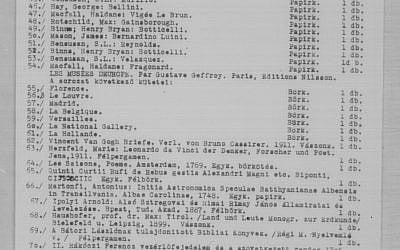
Hungarian archival microfilm, Reel 145, Slide 45 (below) — Continuation of October 17, 1944 Museum of Fine Arts inventory of Baroness Hatvany Deutsch Károlyné’s seized library. Items 36–75 include additional artist monographs, European museum catalogues, correspondence of Vincent van Gogh, and early Hungarian historical works.
The Perpetrators
The operation took place under the watch of Dr. Dénes Csánky, Director-General and Government Commissioner for the Inventory and Safekeeping of Jewish Property. His office directed seizures, coordinated transport, and assigned state institutions to receive specific collections. Museum officials acted as agents of this program, completing intake protocols and storing property as instructed.
This is evidence of an institutional chain of custody:
-
Government commissioner orders seizure.
-
Museum of Fine Arts receives the collection.
-
Staff inventory and store the property with administrative care.
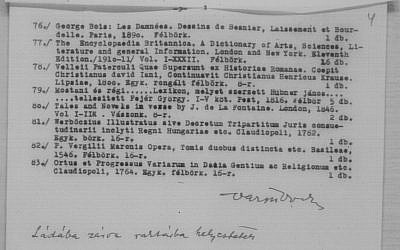
Hungarian archival microfilm, Reel 145, Slide 46 (below) — Final page of October 17, 1944 Museum of Fine Arts inventory of Baroness Hatvany Deutsch Károlyné’s seized library. Items 76–83 include Encyclopaedia Britannica (11th ed.), classical and medieval Hungarian legal texts, and other scholarly works. Handwritten note reads “Placed into box and into a cupboard,” confirming museum storage.
Why This Case Matters
As a piece of historical evidence, these three pages meet the highest evidentiary standards for provenance research:
-
Named victim with address.
-
Exact date of seizure.
-
Complete itemized list of contents.
-
Identified receiving institution and custodial actions.
For restitution, this is a rare instance where all the key elements align. It establishes ownership, the fact of seizure, the path into institutional custody, and the nature of the property. For Holocaust scholarship, it is a vivid example of how Hungary’s wartime art plunder was not chaotic looting but a coordinated, bureaucratic process involving elite cultural institutions.
The Call for Transparency
The Museum of Fine Arts and other Hungarian institutions continue to hold—and in some cases, conceal—provenance records for works taken during 1944. The Hatvany Deutsch library inventory should not be buried in microfilm reels; it should be acknowledged publicly, with a full accounting of whether any of these works or volumes remain in institutional collections today.
Endnotes:
-
Hungarian archival microfilm, Reel 145, Slide 44 — October 17, 1944 museum intake protocol documenting the seizure of Baroness Hatvany Deutsch Károlyné’s private library from her residence at Lánchíd Street, Budapest, and its transfer to the Museum of Fine Arts under the authority of the Government Commissioner for the Inventory and Safekeeping of Property Seized from Jews. Lists items 1–35, including rare art monographs and museum catalogues.
-
Hungarian archival microfilm, Reel 145, Slide 45 — Continuation of the October 17, 1944 inventory, items 36–75, cataloguing additional high-value works, including multi-volume artist monographs, museum catalogues, correspondence of Vincent van Gogh, and early Hungarian historical and astronomical works.
-
Hungarian archival microfilm, Reel 145, Slide 46 — Conclusion of the inventory, items 76–83, listing Encyclopaedia Britannica (11th ed., 1910–1911), classical works, medieval Hungarian legal codes, and other scholarly volumes. Includes handwritten note “Placed into box and into a cupboard,” confirming secure museum storage.