
114 Essays Agree: The Golden Age Is Over
 For seventy years American Jews lived under an arrangement good enough to earn a name: the golden age. Physical safety, open doors, real political influence, and a two-party consensus behind Israel. That arrangement is now being pronounced dead, in public, by the people who lived under it.
The pronouncements are showing up in one place where they can be counted: the blog section of the Times of Israel, where American Jews argue with each other in the open. Since late January, 114 essays have made some version of the case. They are being written three times faster than they were in February. Nobody organized this. Nobody had to. Here’s the count.
| Metric | Reading |
| Posts verified | 114, machine-sorted on my criteria, each confirmed by me against the original page |
| Time span | January 30 to July 22, 2026 (six months) |
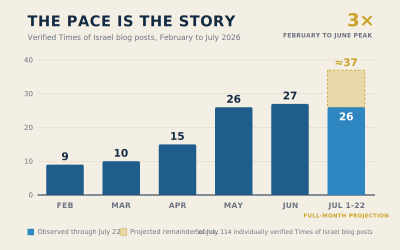
| Monthly volume | 9 → 10 → 15 → 26 → 27 → 26 (Feb-Jul; July through the 22nd, on pace for ~37; four completed-month increases through June) |
| Growth rate | +200% from February to peak (9→27); July’s 26-in-22-days projects to ~37/month, +31% over June’s daily pace |
| Largest spike | 14 posts in 5 days, following the June 23 New York primary |
| Second spike | 11 posts in 10 days, following the July Massie amendment vote |
| Argumentative lanes | 6 distinct, independently-arrived-at, with a 7th cross-cutting generational strand |
| Key vote 1 | 40 of 47 Senate Democrats moved to block arms sales (April) |
| Key vote 2 | 103 House Democrats backed barring all State Department funds for Israel (July) |
| Prescriptive consensus | None; diagnosis unanimous, treatment divides four ways |
The sorting was machine work: AI tools classified candidate posts against criteria I defined. The verification was mine: author, date, thesis, checked against the original page, not a search snippet, for all 114 posts published between late January and July 22, 2026. This isn’t a pile of anxious essays. It’s a structured discourse with a growth curve, event-driven spikes, a shared vocabulary, and six lanes that writers keep rediscovering on their own.
The pace is the story nobody inside it can see
9 posts in February. 10 in March. 15 in April. 26 in May. 27 in June. 26 in the first 22 days of July, a daily pace 31 percent above June’s, projecting to roughly 37 posts for the full month. Four consecutive completed-month increases through June, with July running at a higher daily pace. No down-months. The base rate tripled, February to peak.
It’s event-driven too, and that’s what makes it real instead of manufactured. Real trends have triggers. The biggest spike, 14 posts in five days, followed the June 23, 2026 New York primary. The second, 11 posts in ten days, followed the mid-July Massie amendment barring any State Department funds for Israel, including $3.3 billion in annual security assistance, the same vote that produced Benami’s essay. Smaller spikes followed the mid-April Senate arms-block vote (40 of 47 Democrats) and Massie’s May primary win in Kentucky. Congress votes, or Mamdani speaks, and the section fires the same essay again. Same conclusion. New byline. Every time.
Two weeks ago, Dory Benami wrote “Bad Jew,” reclaiming the label for anyone who won’t pay what the coalitions charge for acceptance. It reads like a one-off. The count says otherwise.
Six lanes, one destination
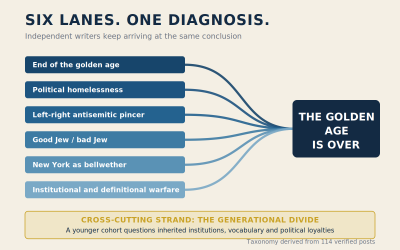 Grouped by argument rather than date, the 114 posts sort cleanly into six lanes. No forcing required, no leftover “other” bucket. Political-homelessness is the largest cluster by a clear margin. Institutional and definitional warfare is the smallest, but still substantial, not a stray outlier. Six real clusters and no long tail of one-offs is itself the signal. This is a discourse with structure, not a grab-bag of hot takes.
The epitaph writers put dates on the good years. Steven Windmueller marks a “golden age of American Judaism,” 1948 to 2018, from Israel’s founding to the Tree of Life shooting. Andres Spokoiny goes further and says American Jewish exceptionalism itself is ending, and that “political homelessness” is the honest posture now. Naming an era closed is a rhetorical move. It turns a bad stretch into settled history. The dissents prove it. Jacki Karsh insists America is “still a Jewish miracle”, which is really an argument against a consensus she can feel forming around her.
The political-homelessness writers are the largest cluster. Same sentence, over and over: “I didn’t leave the party, the party left me.” Brad Goverman’s version is The Democratic Party I Joined. Alan Dershowitz’s is “they left me.” The evidence is specific. 40 of 47 Senate Democrats moved to block arms sales in April (Kalaydjian). 103 House Democrats voted in July to bar all State Department funding for Israel (Mallett; Wenick). Mitch Mallett, founder of the Facebook group “We Are Progressive, Liberal, Woke and Pro Israel” (Times of Israel author page), argues pro-Israel Democrats should stay and fight, not exit. Stuart Weinblatt wants the opposite, a formal divorce from the DSA.
The DSA’s own platform hands this lane its hardest evidence yet. “Workers Deserve More,” adopted mid-July 2026, calls for ending US military and economic aid to Israel and an immediate Gaza ceasefire. On the domestic side it also wants to abolish the USanti Senate, replace the president and Supreme Court with bodies chosen by Congress, and scrap the Electoral College (City Journal; Washington Times; DSA’s platform text). That’s not a faction anyone can persuade. That’s a different political project, which is exactly why the stay-or-leave fight in this lane is so sharp.
The pincer theorists say antisemitism now comes from both directions at once. Itamar Arel reaches for Weimar Germany’s “Schlageter Line”, the Communist outreach to nationalists. Menachem Rosensaft calls it “equal opportunity bigotry.” The staged-decline sequence shows up twice, worded differently. “Presumption of guilt, then normalization, then institutionalization,” says Lev Ari. “Outhouse to living room to public square,” says Twersky.
The good-Jew/bad-Jew lane produced Benami’s essay, but he’s not alone in it. Tsahi Shemesh calls Jewish anti-Zionists a “kosher stamp” that legitimizes hostile spaces. Saul Chapnick reaches for the ugliest comparison in the whole corpus, calling Brad Lander and Bernie Sanders Rumkowski and Quisling. Barry Mellinger’s “Mamdani’s Jews” describes the deal directly: selected Jews certify anti-Israel rhetoric as acceptable, in exchange for a seat at the table. Richard Diamond pushes back. Judaism is fracturing, and “we are doing it to ourselves.”
New York as bellwether treats Mamdani’s mayoralty as the live test case. He took office at midnight on January 1, 2026, the city’s 112th mayor, sworn in publicly that afternoon by Bernie Sanders (CNN; Wikipedia), and moved fast to revoke several of his predecessor’s executive orders on day one. Elkana Bar Eitan calls it flatly, the end of the New York era. Abe Gurko cuts against the grain. The DSA simply ran better politics, better volunteers, better organizing, against fragmented institutions. Organized people beat disorganized people. That’s a competence problem, not an ideology problem, and it’s worth remembering before every setback gets read as antisemitism.
Definitional and institutional warfare is the technical lane: what IHRA’s definition actually does (Clark; Yohay), and whether legacy organizations still represent anyone. Steven Windmueller, seven posts across five months and the corpus’s most prolific writer, predicts a decade of institutional replacement wars as older umbrella groups lose younger donors.
A seventh strand cuts through all six, the generational split. Seth Winberg points to the gap between the 37 percent of American Jews who call themselves Zionists and the 88 percent who back Israel’s existence as a Jewish state, a gap he blames on thin history, not ideology. “You cannot argue someone into a bond.” That’s the whole generational problem in one line.
What this actually tells us
Read one at a time, these 114 posts are grief, advocacy, polemic. Not analysis. Read together, they do something no single post can. They show the demand side of the market I described on this platform six months ago. I modeled how coalitions price Jewish acceptability. This corpus is the group being priced, responding in real time, with no coordination, and converging anyway.
Three things I didn’t expect.
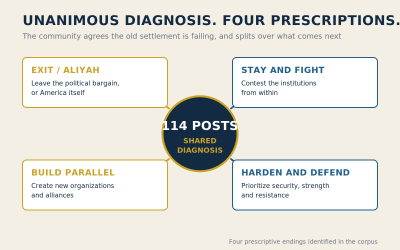
The prescriptive split is wider than stay-or-leave. Four endings, not two: exit and aliyah (Breman; Alvarez Gomez); stay and fight (Mallett); build parallel institutions (Apisdorf; Engelmayer); harden and defend (Schindler; Sternberg). Everyone agrees on the diagnosis. Nobody agrees on the treatment, and that gap is doing its own damage, per Diamond and per Windmueller.
The “who decides” question shows up as a named complaint, not an abstraction. Shulamit Magnus asks it outright: “who decides Jewish identity? Not the mayor of New York.” The same complaint, an outsider setting the terms of who counts as legitimate, surfaces independently across a dozen posts tied to a dozen different incidents. That’s stronger evidence than any one essay could produce alone.
No single writer notices the section went from 9 posts a month to 27. Each one thinks they’re describing one event: a vote, a primary, a coffee shop ban. Only the aggregate shows the events arriving faster and the volume climbing louder every time. If you want hard evidence that “the golden age is over” is a live, present-tense claim and not a rhetorical flourish, this is it. The monthly volume of posts independently arriving at versions of that conclusion tripled in five months.
The bottom line
 I’ve written elsewhere about what it would take to get back to something like the Clinton-era consensus: an actual end to the war, a costly re-imposition of party discipline on both sides, time for generational turnover. This corpus doesn’t change that math. But it measures something the math couldn’t: how far the community believes it has already traveled from that baseline, and how little agreement there is on the way back.
Nobody in these 114 posts is arguing for a return to boring bipartisan consensus as a near-term goal. That question is already dead. The live question is harder. Given that the old arrangement isn’t coming back on any predictable clock, what does this community do with the next decade? The corpus offers four competing answers: leave, remain and fight, build parallel institutions, or harden and defend. Nobody convened that symposium either. The disagreement over treatment may be the clearest proof yet that the diagnosis has taken hold, whether or not anyone can say exactly when the era ended.
A note on method: this analysis is machine-assisted by design. I set the inclusion criteria, drawn from the framework in my earlier essay on what political coalitions charge Jews for acceptance: posts whose central argument concerns the deteriorating political position, security, institutional standing, or terms of acceptance of American Jews. AI tools did the sorting at scale against those criteria. I then checked every included post against the original page for author, publication date, and central thesis; posts in which these subjects appeared only incidentally were excluded. These are absolute counts, not counts normalized against total Times of Israel Blogs volume. They measure the accelerating volume of this particular discourse, not its share of everything published on the platform.
Sources: based on 114 individually verified posts from Times of Israel Blogs (blogs.timesofisrael.com), published January 30 to July 22, 2026. Every title, author, date, and thesis confirmed against the original page. Full citation list available on request. Key posts: Benami, “Bad Jew”; Windmueller, “Back in History”; Spokoiny, “American Jewish exceptionalism is ending”; Mellinger, “Mamdani’s Jews”; Gurko, “What Happened in New York Is a Cautionary Tale”; Winberg, “Many young Jews support a binational state”. Mitch Mallett bio: Times of Israel author page. DSA platform: “Workers Deserve More”; City Journal; Washington Times. Mamdani inauguration: CNN; Wikipedia.