From Archive to AI: Tracing Holocaust Looted Art
The Holocaust Art Recovery Initiative (HARI) has advanced the field of cultural property restitution by merging three essential elements: preserved wartime archives, advanced artificial intelligence and forensic analysis, and intensive human investigation. Working alongside Holocaust survivor and researcher Clara Garbon-Radnoti, and with retired Zekelman Holocaust Center librarian Feiga Weiss, HARI has linked Hungarian wartime seizure records to specific artworks in public and private collections today. This combination of technology and expertise is changing the rules for provenance research, cutting years off traditional timelines, and producing actionable evidence for restitution.
Introduction
For decades, the hunt for Holocaust-era looted art was slowed by incomplete archives, secretive institutions, and labor-intensive provenance research. Families who knew what was taken often waited decades for proof.
HARI’s approach has shifted that balance. Starting with 180 reels of wartime Hungarian government microfilm preserved by the late Holocaust scholar Randolph L. Braham at the Zekelman Holocaust Center in Michigan and digitized by the U.S. Holocaust Memorial Museum and World Jewish Restitution Organization, we built a research framework that pairs AI and forensic analysis with hands-on historical investigation.
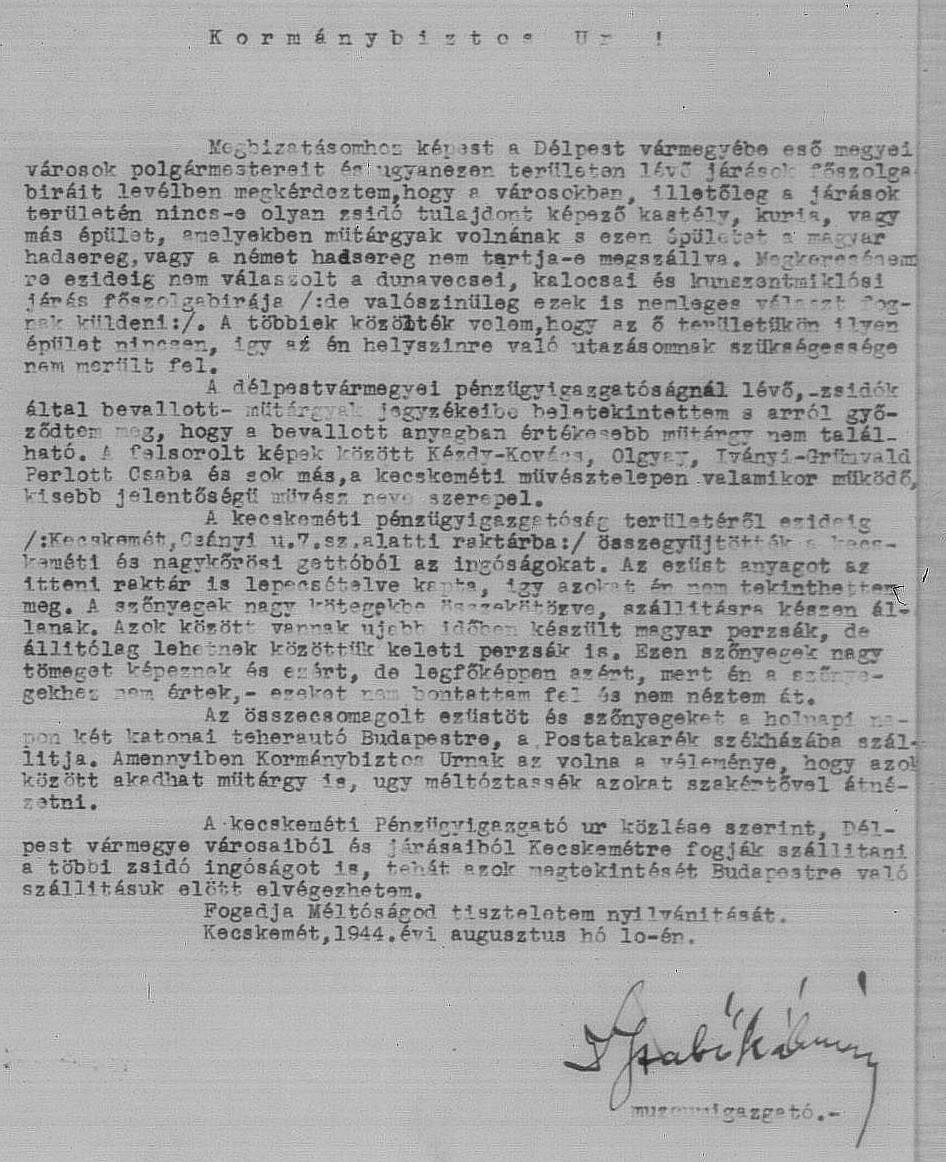
These reels contain thousands of pages of official inventories, museum intake forms, ministry correspondence, and receipts on government letterhead for looted Jewish cultural property. AI tools could search and cross-reference them, but the breakthroughs came from human insight — manually scanning headings, researching names, tracking artworks, and investigating leads. That work led to uncovering a modern state-of-the-art storage facility in Budapest (OMRRK) that houses national collections, and even to tracing a leading wartime figure to Brazil.
Historical Background
In 1944, Hungary deported over 437,000 Jews to Auschwitz in just eight weeks. Alongside the deportations, the state ran a systematic confiscation program. Cultural property was seized under legal decrees, guarded by armed gendarmes and police, inventoried by museum and ministry officials, and redistributed to national and regional institutions.
Microfilm reels 143, 144, and 145 document this process in extraordinary detail — naming victims, describing specific works, recording destinations, and preserving signatures of perpetrators.
Examples of Key Discoveries from the Microfilm Archive
-
- Institutional Complicity Lists – Reel 143, Slides 4–20 name over 20 Hungarian museums tasked with receiving, cataloging, and storing looted Jewish cultural property.
-
High-Value Inventories – Reel 145, Slides 390–410 record Old Masters and Hungarian modernists from collections such as Baron Ferenc Hatvany and the Herzog family.
-
Bank Collaboration – Reel 143, Slides 460–480; Reel 145, Slides 400–420 show banks, including the Magyar Leszámítoló és Pénzváltó Bank, opening Jewish safe-deposit boxes, inventorying contents, and turning over valuables — including museum-quality paintings — to the state.
-
High-Value Non-Art Cultural Property – Reel 143, Slides 360–380 and Reel 144, Slides 300–320 document the seizure of gold and silver coins, jewelry, rare books and manuscripts, scientific instruments, Chinese and Japanese porcelain, Persian carpets, Judaica, and ethnographic artifacts from prominent Jewish families. These inventories detail items of significant monetary, historical, and cultural value, many of which were routed into museums, libraries, and state collections.
-
Furniture and Domestic Interiors – Reel 143, Slides 311–320 and Reel 145, Slides 530–550 record the confiscation of complete household furnishings, including Rococo and Empire pieces, upholstered seating, dining suites, wardrobes, clocks, and decorative objects. Many were assessed for “museum use” or integrated into government offices and state residences.
-
Natural History and Scientific Collections – Reel 143, Slides 700–710 and Reel 144, Slides 372–380 list rock and mineral collections, fossils, botanical specimens, and mounted animals, as well as laboratory microscopes, telescopes, surveying instruments, and cameras. These were often absorbed into teaching collections of universities, secondary schools, and museums.
-
Children’s Possessions – Reel 144, Slides 360–370 document dolls, toy trains, wooden blocks, and youth literature taken from Jewish homes. Many of these items were redistributed to orphanages or routed into school libraries without acknowledgment of origin.
-
Religious and Ceremonial Items – Reel 143, Slides 600–615 and Reel 145, Slides 420–430 record the seizure of Torah scrolls, menorahs, bimah cloths, ritual silver, and other Judaica, along with church and synagogue organs, prayer books, and religious manuscripts. Many were transferred to the Hungarian National Museum, the Museum of Fine Arts, or regional cultural institutions, often mislabeled or kept in storage to obscure their provenance.
-
Perpetrator Signatures – Many documents are signed by Dr. Dénes Csánky, head of the Ministry’s Museum Department, who oversaw the national intake system.
-
Regional Hubs – Győr, Békéscsaba, Baja, Székesfehérvár, and Hatvan served as regional collection points before shipments to Budapest.
-
Teacher and Student Involvement in Looting – Documents from June–July 1944 (Reel 143, Slides 705–711) reveal that the Ministry of Religion and Public Education formally ordered state-employed secondary school teachers — and in some cases their students — to inventory, classify, and redistribute cultural property seized from Jewish homes. These records show the education sector’s direct role in the machinery of cultural plunder.
AI and Forensic Methods
-
Custom OCR – AI trained on wartime Hungarian and Gothic fonts converted scans to searchable text, enabling cross-referencing with external databases.
-
Neural Translation – Engines fine-tuned for historical Hungarian bureaucratic language produced highly accurate English translations for faster identification.
-
Computer Vision – Image-matching algorithms linked archival photographs to museum holdings and auction catalogs, compensating for reframing or restoration.
-
Forensic Analysis – Conservators examined pigments, canvas, and backings, sometimes revealing hidden wartime seals under later layers.
Human Investigation and Field Research
Technology found patterns; people found the story. Clara Garbon-Radnoti spent over a decade translating reels and flagging art-related entries. Feiga Weiss connected Clara’s work to HARI’s in late 2018, launching a multi-year collaboration.
HARI’s investigative work combined meticulous review of reel headings with tracking names through museum catalogs, public records, and archival references. By following these trails both offline and online, the team uncovered key facts and forged groundbreaking connections—proof that traditional detective work remains indispensable alongside new technology.
Case Studies
-
Herzog Gauguin – Reel 144, Slides 70–90 list a Paul Gauguin painting seized from the Herzog family. AI image search found a potential match in a Hungarian state collection.
-
Balaton Museum Shipment – Reel 143, Slides 770–790 show the Balaton Museum receiving Chinese porcelain, European paintings, and other looted property, some of which remain in regional museum displays.
-
Hatvany Cranach – Reel 145, Slides 340–360 include records of a painting by Lucas Cranach the Elder seized from Baron Ferenc Hatvany in 1944. Using image-matching technology, HARI linked the description and archival photographs to a work now held in a European museum, which is currently the subject of an active restitution claim.
Perpetrators & Institutional Complicity
The evidence implicates:
-
Museums – National Museum, Museum of Fine Arts, Balaton Museum, Déri Museum, and others accessioned looted works.
-
Ministries – Ministry of Religion and Public Education, with Csánky directing operations.
-
Banks – Magyar Leszámítoló és Pénzváltó Bank and others inventoried and surrendered Jewish assets to the state.
-
Security Forces – Gendarmes and police guarded shipments, storage sites, and enforced compliance under threat of arrest.
- UNESCO World Heritage Sites – Several institutions implicated in the archival record operate within UNESCO-listed sites or hold collections tied to such locations. Their participation in, or retention of, Holocaust-era looted cultural property raises acute questions about how these sites reconcile heritage preservation with the unresolved provenance of their holdings.
Modern Implications
The archival record shows that many “lost” works are not lost — they remain in public collections, mislabeled or unlisted online. Combining microfilm evidence, AI cross-matching, and human-led research now allows for direct linkage between 1944 seizure records and physical works.
Policy Recommendations
-
Mandatory provenance audits of museums and banks for items with 1933–1950 provenance gaps.
-
Open wartime archives and digitize them for public access.
-
Expand international data-sharing for restitution research.
-
Support legislative measures like the HEAR Act Improvements to ensure claims are heard on their merits.
- Commit to Full Restitution or Meaningful Resolution – Museums and institutions identified as holding Holocaust-era looted art should promptly return such works to their rightful heirs or engage in transparent, good-faith restitution negotiations. Doing so not only fulfills legal and moral obligations but also restores public trust and reaffirms their role as honorable stewards of cultural heritage.
Conclusion
From Clara’s painstaking translations at a microfilm reader, to AI servers matching looted artworks worldwide, to field research identifying hidden storage and living perpetrators, this project proves the power of combining human skill and technological innovation. Documents alone are static; technology alone is blind. Together — with legal insight, historical knowledge, and investigative drive — they become a force that can still bring truth and justice eight decades later.
The path from archive to algorithm is not just about recovery of objects — it is about restoring history, dignity, and the record of what was taken. With these tools, the advantage has finally shifted toward those seeking the truth.
Endnotes:
-
Hungarian government microfilm, Reel 143, Slides 4–20, Zekelman Holocaust Center Archive.
-
Hungarian government microfilm, Reel 145, Slides 390–410, Zekelman Holocaust Center Archive.
-
Hungarian government microfilm, Reel 143, Slides 460–480; Reel 145, Slides 400–420, Zekelman Holocaust Center Archive.
-
Hungarian government microfilm, Reel 144, Slides 70–90, Zekelman Holocaust Center Archive.
-
Hungarian government microfilm, Reel 143, Slides 770–790, Zekelman Holocaust Center Archive.
-
Hungarian government microfilm, Reel 145, Slides 340–360, Zekelman Holocaust Center Archive.
-
Personal interviews with Clara Garbon-Radnoti and Feiga Weiss, HARI archives, 2018–2025.
Appendix: Named Victims, Institutions, and Seizures
(Grouped by victim/institution, with reel ranges)
Baroness Hatvany Deutsch Károlyné – Reel 145, Slides 40–60
Private library seized from Lánchíd Street, Budapest; included rare art monographs, classical works, and Encyclopaedia Britannica; transferred to Museum of Fine Arts.
Baron Ferenc Hatvany – Reel 145, Slides 340–360
Lucas Cranach the Elder and other works seized; entered state collections.
Herzog Family – Reel 144, Slides 70–90
Old Masters and modernist works, including Paul Gauguin, taken and redistributed to state museums.
Strauss Pál – Reel 144, Slides 340–360
Five paintings seized, one attributed to Rubens; delivered to Museum of Fine Arts.
Dr. Endre Gáspár – Reel 145, Slides 390–410
Scientific instruments, paintings, and cultural property confiscated under ministry orders.
Mrs. Ignácné Michelisz – Reel 145, Slides 390–410
Cultural property, including paintings, seized and inventoried by Hungarian officials.
Arany Dániel – Reel 144, Slides 340–360
Personal library and effects confiscated; routing recorded to state repositories.
Br. Kornfeld Móric – Reel 144, various ranges
Paintings, sculptures, books, and Judaica transferred to Museum of Fine Arts.
Magyar Leszámítoló és Pénzváltó Bank – Reel 143, Slides 460–480
Bank held 15 paintings in a Jewish-owned safe-deposit box; reported to Dr. Csánky; transferred to state custody.
Balaton Museum – Reel 143, Slides 770–790
Received Chinese porcelain, European paintings, and decorative arts from looted collections.
Prepared by the Holocaust Art Recovery Initiative (HARI), 2025
Contact: HolocaustArtRecovery@yahoo.com | HolocaustArtRecovery.org