
Russian-American-Israeli Palestinian. Palestine is Israel.
My Reverse Canary Mission Profile
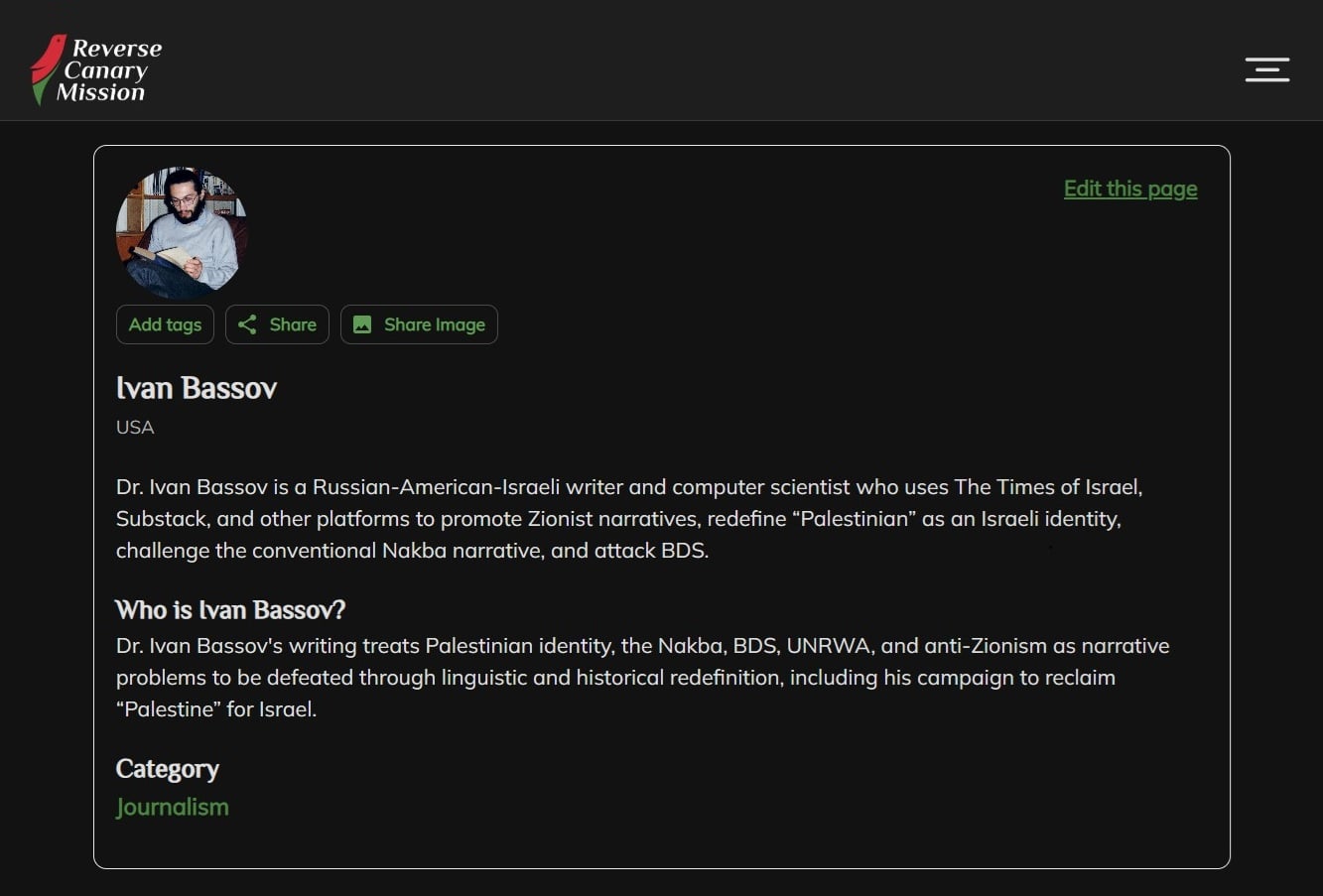
“It’s time to hold Zionists accountable.” Screenshot of Ivan Bassov’s Reverse Canary Mission profile, captured October 3, 2026. Reverse Canary Mission is an anonymously operated online doxxing and documentation website. Content is reproduced for purposes of commentary and analysis; the website’s original text, compilation, and presentation remain the intellectual property of their respective creators.
The Case Against Ivan Bassov, According to RCM
In my article “Canary Mission and Reverse Canary Mission,” I wrote:
There are two websites that have struck me as particularly interesting: Canary Mission and its ideological counterpart, Reverse Canary Mission.
Both are political databases that collect information about people and organizations whose public activities they regard as concerning. Both assemble scattered statements, affiliations, photographs, social-media posts, and other publicly available material into searchable profiles. And both are clearly ideological.
I am now listed by Reverse Canary Mission.
Interestingly, RCM does not have Israel in its list of countries, but it does have “Palestine” and “Occupied Palestine.” The site also blocks access from Israeli IP addresses. If you are reading this from Israel, you can check the archived copy of my profile or use a VPN to explore the platform.
See that article for my thoughts about both sites and my position on being listed by one of them.
Some of my readers have suggested that being listed by Reverse Canary Mission is a badge of honor. I wholeheartedly agree. Being singled out by an ideological organization for expressing unfashionable or inconvenient views is hardly something I consider a liability. I am particularly proud to be listed alongside many respected Israeli advocates whose voices carry considerable weight, including people I am connected to, follow, and interact with on LinkedIn and other platforms.
For my Israeli readers, I am reproducing below the full text of my Reverse Canary Mission profile for convenient access. I have not edited or corrected the text; it is presented exactly as RCM published it.
* * *
Reverse Canary Mission
Ivan Bassov
USA
Dr. Ivan Bassov is a Russian-American-Israeli writer and computer scientist who uses The Times of Israel, Substack, and other platforms to promote Zionist narratives, redefine “Palestinian” as an Israeli identity, challenge the conventional Nakba narrative, and attack BDS.
Who is Ivan Bassov?
Dr. Ivan Bassov’s writing treats Palestinian identity, the Nakba, BDS, UNRWA, and anti-Zionism as narrative problems to be defeated through linguistic and historical redefinition, including his campaign to reclaim “Palestine” for Israel.
A Writer Recasting the Israel-Palestine Narrative
Dr. Ivan Bassov is a Russian-American-Israeli writer and computer scientist whose political writing focuses heavily on Israel, Zionism, Palestinian identity, the history and meaning of the term “Palestine,” the Nakba, BDS, UNRWA, and what he calls “Ziophobia.”
Bassov publishes extensively through The Times of Israel, Substack, Medium, and other platforms. His writing is characterized by an explicit effort to challenge prevailing terminology and narratives surrounding Israel and the Israeli-Palestinian conflict.
The “Palestine = Israel” Project
A central theme of Bassov’s recent writing is his campaign to reclaim the name “Palestine” for Israel.
In Palestine, That Is Israel, Bassov argues that Israel and Palestine should not necessarily be understood as mutually exclusive political entities. He proposes that Israel adopt “Palestine” as an official exonym while retaining “Israel” as its Hebrew endonym. His formulation is explicit: “Palestine is Israel.”
In Hands Off My Palestine, Bassov develops the argument further, describing the struggle over Palestine as fundamentally a struggle over who has the authority to define the name and its meaning. He argues that the word “Palestine” should not be treated as the exclusive property of the anti-Israel movement.
This campaign is presented by Bassov as a project of linguistic and historical reclamation rather than merely a dispute over terminology.
Reclaiming the Term “Palestinian”
Bassov extends the same argument from geography to personal identity.
He describes himself as a “Russian-American-Israeli Palestinian”, explicitly explaining the designation through his proposition that Palestine is Israel. His writings argue that Israelis—including Jewish and non-Jewish citizens—can and should reclaim the designation “Palestinian.”
Bassov objects strongly to the contemporary use of “Palestinian” as an exclusive designation for non-Israeli Arab populations. In The Clientele, he explicitly advocates replacing that usage with “UNRWA Clientele” or “the Clientele.”
His broader argument is that terminology itself has become a political instrument: whoever controls the names controls the conceptual framework through which history, geography, and political legitimacy are understood.
The “Palestinian Identity Manifesto”
Bassov has developed these ideas through a series of essays and projects collectively centered on what he calls the Palestinian Identity Manifesto and the Palestine Project.
His writing argues that the contemporary political meaning of “Palestinian” should not be treated as an ancient or self-evident historical fact. He disputes narratives that present the modern Palestinian identity as a timeless national identity extending unchanged into antiquity.
His Palestine Project and related essays repeatedly return to the proposition that Israel and Palestine can be understood as two names for the same country, rather than necessarily representing two competing national entities.
Reframing the Nakba
The Nakba is another recurring subject in Bassov’s writing.
Rather than accepting the conventional presentation of the Nakba as a foundational Palestinian national narrative without qualification, Bassov seeks to replace its dominant focus on the 1948 displacement of Arabs with a broader narrative centered on the displacement and flight of Jewish communities from Arab countries. In “Nakba”: You Keep Using That Word…, he challenges the terminology and historical framing surrounding the term “Nakba.”
His writing on the subject includes arguments concerning the creation and perpetuation of refugee identities, the role of UNRWA, and what he describes as the transformation of displacement into a permanent political and institutional framework.
Bassov has also written about Jewish refugees and displaced communities from Arab countries, emphasizing their history as a counterpoint to narratives that focus exclusively on Arab displacement in 1948. In November 30 — Nakba Day: The Jewish Expulsion and Flight from Arab Lands, he focuses specifically on the displacement and flight of Jewish communities from Arab countries.
UNRWA and “The Clientele”
Bassov is particularly critical of UNRWA and of the terminology surrounding Palestinian refugees.
He argues that the international system surrounding Palestinian refugees has contributed to the preservation of a distinct political identity based on refugee status across generations. His preferred term, “the Clientele,” is deliberately provocative and is intended to challenge the conventional terminology used by governments, international organizations, and media.
His criticism therefore extends beyond UNRWA itself to the broader vocabulary used to describe the Israeli-Palestinian conflict.
BDS
Bassov is an outspoken opponent of the Boycott, Divestment and Sanctions (BDS) movement.
In essays including Investing in Hypocrisy: The BDS Index Fund and The BDS Index Fund, Revisited, he treats BDS as a political and ideological campaign against Israel and examines the organizations, companies, and institutions associated with boycott activity.
His writing presents opposition to BDS as part of a broader effort to challenge what he regards as exceptional or discriminatory treatment of Israel.
“Ziophobia”
Bassov has developed his own terminology for describing hostility toward Israel and Zionism.
He uses “Ziophobia” to refer to what he characterizes as hostility, prejudice, or obsessive double standards directed at Israel, Zionism, or Zionists. He presents the term as an analogue to antisemitism and argues that some contemporary anti-Israel rhetoric represents a modern form of hostility toward Jewish sovereignty.
In The Enemy Is Ziophobia and Antisemitism Without a Name, Bassov develops this argument into a broader theory of what he considers a contemporary ideological campaign against Israel.
He also uses related terminology such as “Zionistish” and “Ziophobish” to describe positions along a spectrum between support for and opposition to Israel.
Supersessionism and Jewish Historical Continuity
Another strand of Bassov’s writing concerns what he calls supersessionism: the idea that a later religious or political identity can replace, inherit, or supersede the Jewish people’s historical identity, covenant, or connection to the Land of Israel.
In When Theft Calls Itself Revelation and related essays, Bassov connects supersessionist ideas to what he describes as modern anti-Zionist narratives.
His argument is that disputes over Israel are not solely territorial or political but also involve competing claims about historical continuity, identity, and ownership of collective narratives.
Language as a Political Battlefield
Across these subjects, Bassov consistently treats language as a central component of political conflict.
His essays argue that terms such as “Palestine,” “Palestinian,” “refugee,” “Nakba,” “occupation,” “colonialism,” and “Zionism” do more than describe political reality: they establish conceptual frameworks within which political arguments are subsequently made.
His writing therefore frequently attempts to redefine, reclaim, or replace established terminology.
This approach is summarized in his recurring concept of “the Alef-Bet of Meaning”—the proposition that political struggles can begin with control over words, names, categories, and definitions before they become struggles over territory or institutions.
A Sustained Political Writing Project
Bassov’s work is not limited to a single article or political controversy. His publications form a sustained body of commentary addressing Israel, Zionism, Jewish identity, Palestinian identity, UNRWA, BDS, the Nakba, antisemitism, anti-Zionism, and the politics of historical memory.
His recent essays include Names and Narratives, The Battle for “Palestine”, The Clientele, Palestine Is to Israel What Persia Is to Iran, Palestine, That Is Israel, and Hands Off My Palestine, alongside his writings on Ziophobia, supersessionism, BDS, and the Nakba.
Taken together, these writings present a consistent project: challenge the prevailing vocabulary surrounding Israel and Palestine, reclaim disputed terminology, and replace what Bassov regards as an anti-Israel narrative framework with one centered on Israeli sovereignty, Jewish historical continuity, and the identification of Palestine with Israel.
* * *
See Also
Related Topics