
Stolen Faces: The Fate of Holocaust-Era Photos
In the vast bureaucracy of the Holocaust’s cultural plunder, some items were taken purely for their market value — gold, silver, carpets, and even certain paintings earmarked for sale. Others were kept for the glory of the state, destined for the walls of museums or the tables of government offices.
And then there were the photographs.
A family photo album. A wedding portrait. A child’s school picture. These were not taken for profit. They were taken to erase.
From the 1944 Hungarian wartime microfilm reels preserved at the Zekelman Holocaust Center — painstakingly translated by Holocaust survivor and researcher Clara Garbon-Radnoti, with archival expertise from Feiga Weiss — we know that these photographs were recorded, inventoried, and in many cases, delivered to the same museums that took fine art. They were placed in storage, mislabeled, or lost to private hands. And yet, they survive in the records — faces and moments frozen in time, still waiting to be reclaimed.
Why Photographs Matter
-
Identity restored – For countless victims, a photograph may be the only surviving image.
-
Proof of ownership – Images often show the very objects looted from a home.
-
Community reconstruction – Albums capture the geography of vanished neighborhoods.
-
Forensic evidence – Fingerprints, DNA, fibers, and dust can link a photo to a home or person.
-
Generational connection – They bridge families separated by murder and decades.
The Boross Mihály Case
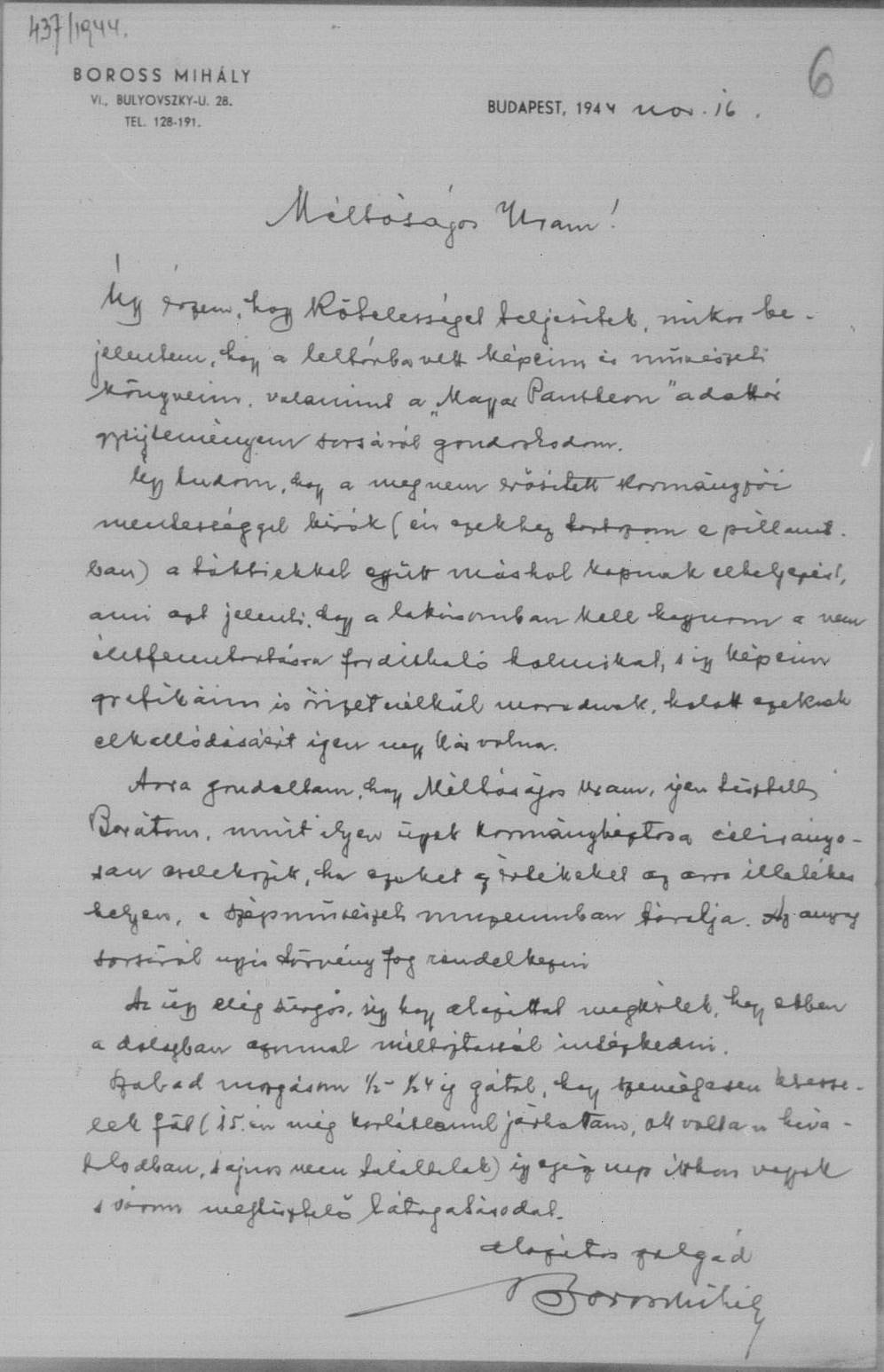
One of the clearest examples appears in an official seizure record dated November 23, 1944 (Reel 145, Slides 392–395). The inventory lists dozens of artworks taken from the residence of Boross Mihály at Bulyovszky Street 23 in Budapest — oil paintings, drawings, sculptures. And in the middle of the list, one simple entry:
“Fénykép: Női arckép” — Photograph: Woman’s portrait.
Alongside valuable paintings, this intimate personal item was confiscated under antisemitic wartime seizure orders and delivered to the Szépművészeti Múzeum (Museum of Fine Arts). It is the human truth of the plunder: the same officials and institutions that took a Munkácsy painting also took a photograph of someone’s mother, sister, or wife.
Other Examples from the Archive
The HARI review of Reels 143–145 reveals multiple documented seizures of photographs, albums, and portraits:
-
Wedding albums from Jewish homes in Székesfehérvár, taken during June 1944 sweeps and routed through the city museum.
-
School class photographs confiscated in Nyíregyháza alongside over 200 paintings stored under armed guard in a gymnasium.
-
Portraits of parents and grandparents seized in Baja during the summer 1944 property roundups, inventoried with silverware, porcelain, and family furniture.
-
Loose photographs and framed images taken from estates in Hatvan, grouped with household clocks, glassware, and personal correspondence.
-
Albums labeled by address in Kolozsvár, documented in regional intake lists before being sent — or in some cases fought over — between local institutions and Budapest ministries.
These were not incidental. They were specifically listed, counted, and signed for on official museum and government letterhead, sometimes with the same perpetrator’s handwriting appearing on both the seizure order and the object list.
Forensic Potential
While photographs have immense emotional and historical value, they also hold physical evidence:
-
Fingerprints on glass plate negatives, album pages, and frames.
-
DNA in binding cloth, adhesive residues, or tucked-in mementos.
-
Handwriting matches in album captions and seizure inventories.
-
Paper and ink dating to confirm authenticity and origin.
-
Background clues in the images that can confirm time, place, and identity.
This is why HARI argues that photographs are active crime scene evidence in the world’s largest unresolved art theft case.
From Archive to Identification
Through a combination of AI tools and human investigation, HARI has begun matching photographs described in wartime seizure lists to surviving images in museum catalogs and online archives, in cases where both wartime descriptions and later images are available for comparison.
In some cases, AI handwriting recognition has confirmed that captions or inscriptions in surviving albums were written by the same individual who signed the 1944 government seizure documents — directly linking the photograph to the official record of its confiscation.
Image-matching algorithms have accounted for decades of cropping, damage, or restoration, allowing us to identify the same image appearing in both wartime documentation and modern collections.
Cross-referencing deportation lists, census data, and property records has restored names to anonymous faces and placed those faces back in the streets, homes, and communities where they once lived.
But technology alone is not enough. It is human expertise — Clara Garbon-Radnoti’s meticulous translations, Feiga Weiss’s archival leads, and Jonathan H. Schwartz’s legal-historical analysis, grounded in art-law experience — that turns an AI match into a fully documented restitution case.
The Urgency
Every year, photographs vanish into estate sales, private collections, or undocumented restorations. Some are cleaned or reframed, erasing forensic clues like inscriptions or fingerprints. Each loss closes another door to history and justice.
These photographs are not curiosities. They are the last witnesses to entire worlds.
Policy and Action
-
Explicit inclusion of photographs in restitution frameworks.
-
Mandatory provenance audits for museum photographic holdings with 1933–1950 gaps.
-
International cooperation under the Washington Principles and Terezin Declaration to return seized family photographs.
-
Archival transparency from institutions holding Holocaust-era photographic materials.
- Immediate digitization and restitution of photographs and albums – Require all museums, archives, and government repositories holding Holocaust-era photographs or albums to scan them at high resolution, make them publicly accessible, and initiate restitution procedures. These materials must be preserved and returned without delay, before further loss, degradation, or dispersal.
Conclusion
A looted painting can restore cultural wealth; a looted photograph can restore an identity, a family, an entire world that was meant to be erased.
These images were taken under the same decrees, by the same hands, in the same terrible weeks of 1944. They are not relics — they are the last witnesses.
Each face in these photographs is still here, looking back at us across the years, asking whether we will consign them to obscurity or fight to return them to their rightful place.
We can still choose. And if we do, those stolen faces will speak again — not as evidence of theft alone, but as proof of lives that mattered.
Appendix: Photographic References in Hungarian Wartime Microfilm (Reels 143–145)
(Ranges given to preserve context and capture full sequences)
-
Reel 145, Slides 392–395 – Boross Mihály, Budapest: Woman’s portrait photograph alongside paintings and sculptures; delivered to Museum of Fine Arts.
-
Reel 144, Slides 300–305 – Székesfehérvár inventories: Wedding photographs, portraits, and albums listed with household valuables; routed through city museum.
-
Reel 143, Slides 700–710 – Nyíregyháza: School class photographs seized with 200+ paintings; stored under guard in gymnasium before redistribution.
-
Reel 145, Slides 351–355 – Baja: Portraits of parents/grandparents and loose photographs; inventoried with silverware, porcelain, and furniture during June–August sweeps.
-
Reel 143, Slides 311–320 – Hatvan: Framed photographs and loose images taken with clocks, glassware, correspondence; municipal and treasury oversight.
-
Reel 143, Slides 630–640 – Kolozsvár: Albums labeled by address; disputes between local museums and Budapest over retention; documented in intake lists.
Prepared by the Holocaust Art Recovery Initiative (HARI), 2025
Contact: HolocaustArtRecovery@yahoo.com | HolocaustArtRecovery.org