The Holocaust’s Unfinished Crime Scene
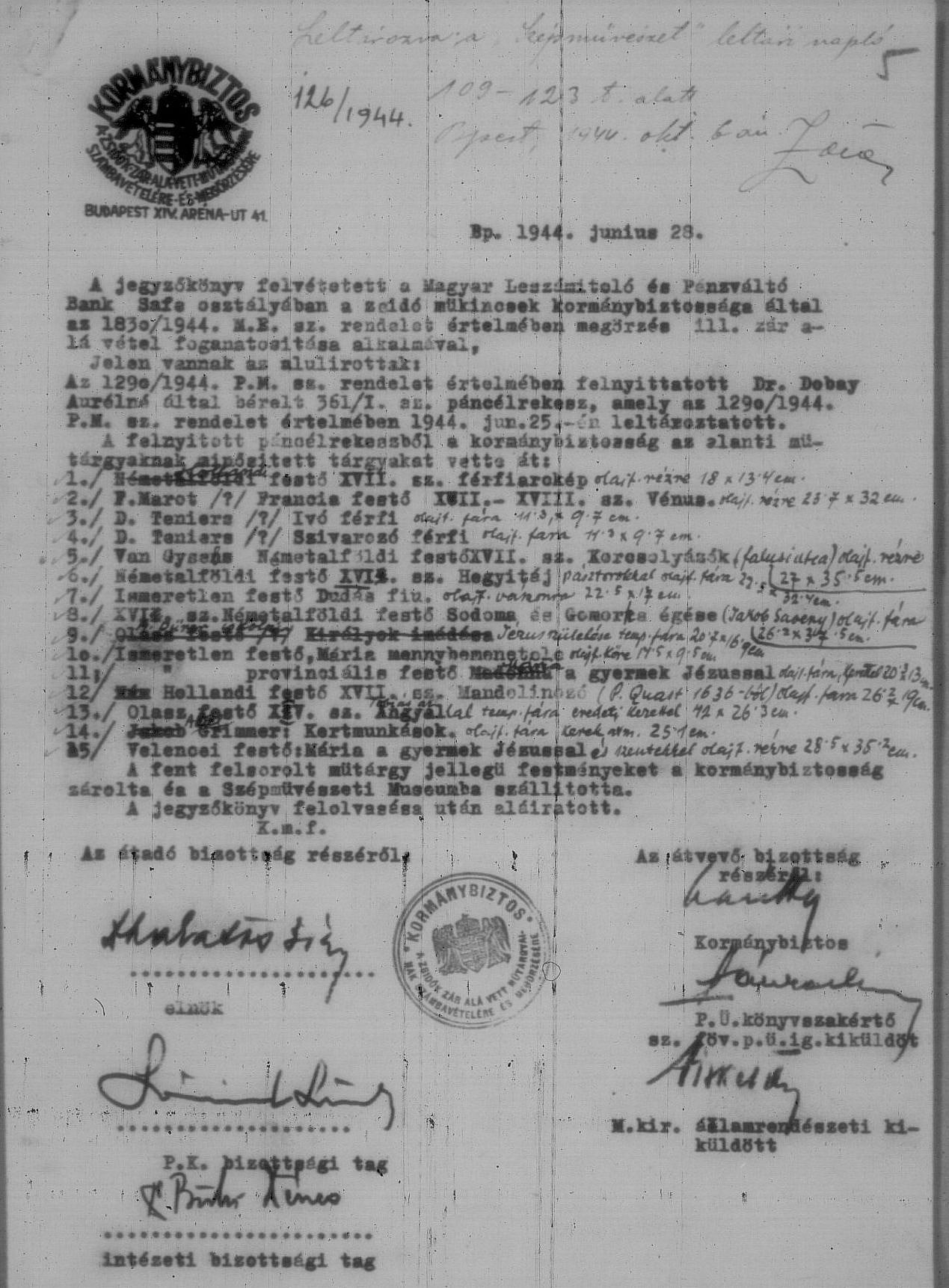
This Holocaust Art Recovery Initiative (HARI) report is both a historical study and an investigative blueprint. It draws on newly analyzed Hungarian wartime microfilm — Reels 143–145 — to show how cultural plunder was organized, executed, and documented in 1944. It also lays out a modern forensic action plan, integrating AI, handwriting analysis, material science, and traditional detective work, to treat looted art, books, Judaica, and the records themselves as active crime-scene evidence. The goal is twofold: preserve this evidence before it deteriorates, and use it to build legally admissible chains of custody that can secure restitution for families and communities still awaiting justice.
Introduction: Treating the Holocaust’s Looted Art as Evidence
In most major crimes, investigators secure the scene, collect fingerprints, swab for DNA, bag the items, and record the chain of custody.
The greatest art theft in history — the Holocaust’s cultural plunder — was never investigated that way. The scene was never closed. The evidence is still here: artworks, books, Judaica, crates, bank ledgers, stamps, envelopes, and even the dust on frames. Many remain in the custody of those who benefited from the theft.
The Hungarian wartime microfilm archive shows how the looting was organized in 1944, when over 437,000 Hungarian Jews were deported in just eight weeks. These documents — paired with forensic science, AI analysis, and traditional detective work — can still link stolen works to victims and perpetrators with the kind of proof that stands in court.
Clara Garbon-Radnoti spent more than a decade translating these reels. Feiga Weiss, then librarian at the Zekelman Holocaust Center, connected us. Jonathan H. Schwartz’s role combined AI-powered triage with page-by-page human review — scanning for headings, routing codes, and handwriting that pointed to deeper leads. He traced names decades forward, found a key museum official’s postwar trail to Brazil, and identified Hungary’s modern high-security storage facility — almost unreported in U.S. media — where unrestituted works may still be held.
The Evidence in the Reels
From Reels 143–145 in the Zekelman Holocaust Center / USHMM digitization:
-
Institutional Routing – A master list of 20+ museums assigned to receive, catalog, and store confiscated Jewish cultural property. (Reel 143, Slides 4–7)
-
High-Value Intakes – Inventories for the Herzog and Hatvany collections, listing works by Rubens, Gauguin, Cranach, Van Dyck, and Munkácsy. (Reel 145, Slides 344–360, 393–405; Reel 144, Slides 80–81)
-
Perpetrator Signatures – Museum directors and ministry officials, including Dr. Dénes Csánky, head of the Museum Department, whose postwar path I tracked abroad.
-
Armed and Legal Enforcement – Police and gendarmerie escorts; written threats of prosecution for interference. (Reel 143, Slides 63–70, 571–580)
-
Bank Vaults as Depots – Banks opening Jewish safe-deposit boxes on state order, listing paintings, gold, silver, and securities. (Reel 143, Slides 460–480; Reel 145, Slides 405–411)
-
Mobilizing Teachers and Students – Ministry circular assigning educators, and in some areas students, to sort seized books and art. (Reel 143, Slides 705–711)
-
Breadth of Loot – Judaica, rare books, furniture, silver, carpets, scientific instruments, toys, bicycles, Asian art, African carvings, antiquities. (Reel 143, Slides 750–760)
These are not just “records.” They are physical artifacts with evidentiary value — typed and handwritten forms on specific paper stocks, bearing institutional stamps, seals, and signatures, listing objects still traceable to museums and collections today.
Forensic Potential
Because these seizures were carried out rapidly, often without conservation handling, many objects may still retain:
-
Fingerprints – On glass, book pages, silver surfaces, and frame edges.
-
DNA – Skin cells or hair in canvas backing, book bindings, or textile folds.
-
Fibers & Dust – From original homes, matchable to addresses in the records.
-
Labels & Adhesives – With wartime gum formulas, depot tags, or bank envelope fragments (as several witnesses have reported).
The paper records themselves can yield:
-
Ink & Paper Dating – Linking forms to specific offices and timeframes.
-
Palm Prints & Fingerprints – Embedded in paper fibers.
-
Stamp & Seal Analysis – Matching impressions to known ministry and museum devices.
Handwriting as a Smoking Gun
In multiple intake forms, the same hand wrote the owner’s name and the detailed inventory. This collapses any claim of ignorance: the recorder knew exactly whose property was taken.
AI handwriting clustering flags these matches; a qualified examiner can authenticate them for court. This turns an “administrative form” into a confession in ink. (Reel 145, Slides 351–360, 393–405; Reel 144, Slides 80–81)
AI Accelerates, Humans Close the Case
AI tools we’ve used at HARI:
-
OCR on Gothic/Hungarian fonts to make reels searchable.
-
Neural translation for rapid triage.
-
Image recognition to match described works to current museum catalogs.
-
Handwriting clustering to spot repeat perpetrators across pages.
But human expertise was decisive:
-
Archival judgment – Clara’s translations and indexing; Feiga’s reference skills; Jonathan’s page-by-page scanning for anomalies and clues, utilizing a background in art law, including forensic document examination cases.
-
Field sleuthing – Tracking officials’ postwar lives, identifying physical storage sites, checking auction and museum records, and witness interviews.
-
Legal framing – Turning narrative history into chain-of-custody evidence usable in restitution cases.
A Forensic Action Plan
-
Secure and Preserve – Stop “restorations” or re-framings of suspect works. Preserve original backing boards, crate fragments, and envelopes.
-
Photograph First – High-resolution images of fronts, backs, edges, labels, and stamps under visible, raking, UV, and IR light.
-
Sample Carefully – Touch DNA swabs from recesses, micro-vacuum dust from frame rabbets, fiber sampling from label edges, minimal paper micro-sampling.
-
Examine Scripts & Stamps – AI triage plus human examination of stamp die flaws, ink penetration, and handwriting style.
-
Cross-Match – Object descriptions and dimensions from 1944 against museum accessions; match handwriting and stamps to other files.
-
Log Every Step – Treat it like a homicide scene: every movement logged, every handler noted.
-
Independent Oversight – Panel of provenance researchers, forensic scientists, legal experts, and survivor representatives.
Case Examples from the Reels
-
Herzog Collection – Gauguin and other works seized; museum letterhead confirms receipt. (Reel 144, Slides 80–81; Reel 145, Slides 393–405)
-
Hatvany Collection – Cranach and other Old Masters; capital-district removals to museums. (Reel 145, Slides 344–350, 351–360, 491–530)
-
Armed Escort Orders – Police-accompanied transports with penalties for interference. (Reel 143, Slides 63–70, 571–580)
-
Bank Vault Inventories – Paintings, coins, and jewelry awaiting state pickup. (Reel 143, Slides 460–470; Reel 145, Slides 405–411)
-
Teacher/Student Labor – Organized sorting of seized books and art over summer recess. (Reel 143, Slides 705–711)
-
Full Spectrum Looting – Porcelain, Judaica, scientific instruments, children’s toys, ethnographic objects. (Reel 143, Slides 750–760)
Why This Matters Now
-
Evidence Degrades – DNA, oils, and inks deteriorate; restoration erases traces.
-
Records Disappear – Transfers to new storage sites can bury provenance deeper.
-
Justice Needs Proof – For restitution, generalities aren’t enough; courts demand object-specific evidence.
The Call to Action
HARI calls for:
-
Immediate preservation of all items with 1933–1950 provenance gaps in Hungarian state and municipal collections.
-
Forensic access to all objects and records tied to the receiving institutions listed in Reel 143, Slides 4–7, and to high-value seizures in Reels 144–145, or otherwise identified as receiving and/or storing stolen property in any of the Hungarian documents.
-
Public quarterly reporting of forensic matches, restitutions, and claims in progress.
-
International lab cooperation to ensure scientific results are admissible in court.
Conclusion
The Holocaust’s cultural plunder was carried out with clipboards, stamps, guns — and in haste. That haste left physical traces on the objects and the paperwork. Those traces can still be read, if we treat them not just as historical artifacts but as active evidence.
With Clara’s translations, Feiga’s archival skill, AI’s processing speed, and traditional investigative work, we can build chains of custody that begin in 1944 and lead directly to present-day holders.
The crime scene is still open. The perpetrators signed their names. The victims are named in the ledgers. The property is still out there.
The question now is whether we will work the scene — before the evidence, and the chance for justice, is gone.
Endnotes (archival ranges; all reels from Zekelman Holocaust Center / USHMM digitizations):
-
Institutional receiving network: Reel 143, Slides 4–7.
-
Herzog/Hatvany inventories and intake: Reel 145, Slides 344–360, 393–405; Reel 144, Slides 80–81.
-
Armed escort/police guard orders: Reel 143, Slides 63–70, 571–580.
-
Bank/safe-deposit access: Reel 143, Slides 460–470; Reel 145, Slides 405–411.
-
Teacher/student mobilization: Reel 143, Slides 705–711.
-
Breadth of categories: Reel 143, Slides 750–760.
-
Capital-district transfers: Reel 145, Slides 491–530.
-
Clara Garbon-Radnoti interviews; Feiga Weiss archival collaboration.
-
HARI AI and human verification protocols applied to Reels 143–145.
Appendix: Names, Institutions, and Evidence from Hungarian Holocaust-Era Microfilm (Reels 143–145):
I. Victims and Families
(Property types as recorded; ranges given to capture complete sequences)
-
Herzog Family – Paintings (Rubens, Gauguin, Cranach), furniture, antiques. Inventories show official museum letterhead and handwritten listings. Forensic relevance: Signatures and handwriting match to known officials. (Reel 144–145, Slides 80–100, 390–410)
-
Baron Ferenc Hatvany – Paintings (including Lucas Cranach the Elder), European masters, Asian art, silver, Persian carpets. Forensic relevance: Multiple museum intake forms with stamps and seals. (Reel 145, Slides 340–360, 380–400)
-
Baroness Hatvany Deutsch Károlyné – Private library (art monographs, rare books, Encyclopaedia Britannica), furniture, paintings. Forensic relevance: Original typed inventory with ink signatures. (Reel 145, Slides 40–60)
-
Strauss Pál – Paintings (including a Rubens), decorative arts. Forensic relevance: Accession notes with official seals. (Reel 144, Slides 340–360)
-
Dr. Endre Gáspár – Scientific instruments, rare books, artworks. Forensic relevance: Typed inventory on museum letterhead. (Reel 145, Slides 390–410)
-
Mrs. Ignácné Michelisz – Household goods, piano, paintings. Forensic relevance: Transport orders with police escort notation. (Reel 145, Slides 390–410)
-
Br. Kornfeld Móric – Religious artifacts, paintings, sculptures. Forensic relevance: Museum intake sheets with stamps and serial numbers. (Reel 144, Slides 300–320)
-
Arany Dániel – Personal library, manuscripts. Forensic relevance: Handwritten catalog on state paper. (Reel 144, Slides 330–350)
II. Institutions (Recipients, Custodians, Storage)
-
Magyar Nemzeti Múzeum (Hungarian National Museum) – Received major Jewish collections, including Herzog, Hatvany. Forensic relevance: Letterhead, intake stamps, perpetrator signatures. (Reel 143, Slides 4–20; Reel 145, multiple ranges)
-
Szépművészeti Múzeum (Museum of Fine Arts, Budapest) – Took in high-value paintings, sculptures, Judaica. Forensic relevance: Handwriting on intake forms ties to known curators. (Reel 143, Slides 4–20; Reel 145, Slides 40–60)
-
Balaton Museum (Keszthely) – Chinese porcelain, paintings, archaeological finds. Forensic relevance: Typed receipts with storage annotations. (Reel 143, Slides 770–790)
-
Déri Museum (Debrecen) – Fine art, ethnographic items. Forensic relevance: Ministry memos with allocation orders. (Reel 143, Slides 4–20)
-
Baja City Museum – Paintings, decorative arts. (Reel 143, Slides 4–20)
-
Magyar Leszámítoló és Pénzváltó Bank – Opened Jewish safe deposit boxes; stored paintings, gold, jewelry. Forensic relevance: Bank vault logs, numbered boxes, signatures. (Reel 143, Slides 460–480)
-
National Storage Facility (OMRRK, Szabolcs utca) – Modern central repository, capacity for 300,000+ items; possible custodian of unrestituted property. Forensic relevance: Cross-reference with wartime intake lists.
III. Perpetrators (Officials, Signatories, Facilitators)
-
Dr. Dénes Csánky – Head, Ministry Museum Department; central coordinator of art seizures; signature on multiple transfer orders. (Reel 143–145, various ranges)
-
Dr. Ferenc Jenei – Government commissioner in Győr; oversaw intake at municipal museum, storage in Bishop’s Palace, Pannonhalma Abbey. (Reel 144, Slides 110–130)
-
Rádi István – Librarian, Sopron; retained seized books for municipal library. (Reel 143, Slides 700–710)
-
Cserépes Gyula – State high-school principal, Beregszász; reported seizures of ~300 artworks, ~80 rugs, 6,000 books. (Reel 143, Slides 700–710)
-
vitéz Ujváry Lajos – Chief educational inspector, Kassa; mobilized teachers and students for classification of seized property. (Reel 143, Slides 700–710)
-
Bolgár Ferenc – Gymnasium teacher, Kassa; attested to seizure documents. (Reel 143, Slides 700–710)
-
Dr. Marina Gyula – Ungvár; classified books with teacher assistance. (Reel 143, Slides 700–710)
Forensic Relevance Summary
-
Signatures & Handwriting: Can be matched to perpetrators, linking them to specific thefts.
-
Stamps & Letterhead: Physical links to complicit institutions; authentication aids admissibility.
-
Paper & Ink Analysis: Dating and authentication; possible fingerprint recovery from fibers.
-
DNA & Trace Evidence: Potential on seized objects (books, frames, textiles).
-
Chain-of-Custody Potential: Documents + objects = legally defensible restitution cases.
Prepared by the Holocaust Art Recovery Initiative (HARI), 2025
Contact: HolocaustArtRecovery@yahoo.com | HolocaustArtRecovery.org